
Brain
- Brain fog
- Memory changes
- Headaches

Guide
What to notice in your body, what to do in your home, and the support tools I'm using right now.
Last updated: July 2026
Supporting your body while you investigate possible exposure is different from finding and fixing a moisture or mold source in your home. Both can matter at the same time, but body support does not replace environmental testing, source control, or qualified remediation.
My boundary: This is my personal experience and an educational map—not a diagnosis or a replacement for individualized medical care.
After my son and I felt flu-like for about two months, my testing raised questions about mold and mycotoxin exposure. A Vibrant Labs Total Tox test—taken after elevated heavy metals—added to those concerns, but I don't believe it is the right next step for everyone. Earlier home testing had found mold in our attic, and I wonder whether replacing our HVAC may have disturbed it. That connection is still only a working theory while home testing and remediation continue.
I created this body map because mold can show up in ways that feel completely disconnected. Use it to notice patterns and bring better questions to your practitioner—not to diagnose yourself or make mold the answer for every symptom.
Wondering whether mold may be affecting your health? Sinclair Kennally’s free mold quiz is a helpful place to start.
Take the free mold quiz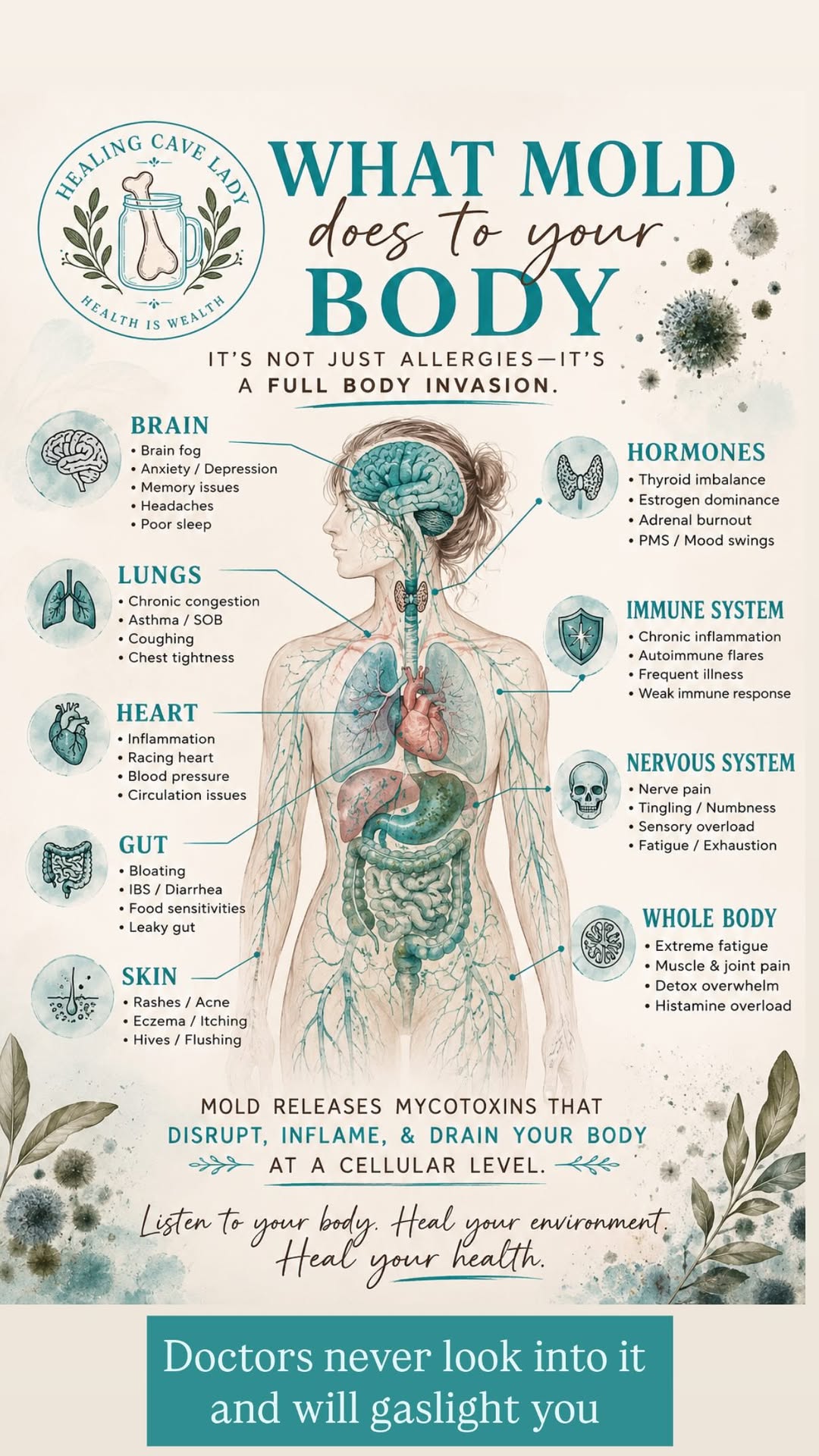 Tap to enlarge
 These symptoms are nonspecific, and mold is not the only possible cause. If you have felt dismissed, that experience is valid context for continued questions and appropriate medical and environmental evaluation—not proof of one diagnosis.
I learned this the hard way: a stronger reaction does not prove that more detox is working better. When sauna, intense routines, or too many changes outpace what my body can tolerate, I pull back. Rest, gentler movement, and recovery days are part of my approach—not time lost from it.
Choose an amount of movement, heat, or stimulation that leaves room to notice how you respond.
Sleep, breathing, sunshine, easy walks, and quiet days can be the work your system needs most.
If a support tool consistently leaves you feeling worse, reduce the intensity and bring the pattern to a qualified practitioner.
This is not a numbered protocol or a stack everyone should copy. Lymphatic drainage is the shared purpose behind walking, rebounding, and heat; I choose among these support tools based on what my body can tolerate that day.
Low-intensity support I can return to consistently.
I use Rest as part of winding down and protecting deep recovery. In this mold context, it supports the rest side of my routine—it is not a mold treatment.
Walking is my most accessible way to support circulation, lymphatic movement, daylight exposure, and nervous-system regulation without chasing intensity. If walking is painful or movement doesn't feel comfortable, I use the Bon Charge Infrared PEMF Mat as a passive way to support circulation, lymphatic movement, and nervous-system regulation.
A hydrating alternative to soap that supports the skin—one of the body’s natural elimination pathways. For some people, oil washing feels gentler when their skin is prone to dryness, rashes, eczema, or hives.
Support tools I scale up, scale down, or skip based on capacity.
Rebounding is one way I add rhythmic movement for lymph and circulation. On lower-capacity days, walking may be enough.
I use sweating and sauna as circulation support when I tolerate heat well.
Heat caution: Start conservatively, hydrate and replace electrolytes, pay attention to heat tolerance, and stop if symptoms tell you the session is too much.
The reasons I use red light are support-oriented: cellular energy, inflammation balance, lymph and circulation, respiratory support, gut and tissue healing, and relaxation and sleep. Some of those rationales are proposed mechanisms or personal experience—not proof that red light treats mold illness.
Products I use for a specific purpose, with more attention to timing and individual context.
ToxinPul is the binder I show in my current routine, while my Top Binders plan gives broader options for mold and environmental support. That is my personal choice, not a universal dose or instruction.
Binder caution: Timing matters—separate binders from food, supplements, and prescriptions; monitor hydration and bowel function; and ask your practitioner or pharmacist about interactions and the right option for you.
I use HistoComplex for mast-cell and histamine support when my system is reactive. General mast-cell or histamine support is not the same as diagnosing or treating MCAS, and this is not an MCAS-specific protocol.
I personally take three capsules in the morning and three before bed, but your needs may be different. Listen to your body and adjust thoughtfully.
Keep the environmental job professional-first: reduce exposure, identify the moisture source, understand the extent, and follow a qualified remediation plan.
If you find visible mold or uncover water-damaged material, don't start tearing, scrubbing, or running fans across it. Disturbing moldy material can send particles into the air and move them into otherwise unaffected spaces. Step away from the area, limit access, and get qualified guidance on the extent and the right level of containment.
Keep children, pets, and anyone who is especially sensitive away from the affected area while you arrange an assessment.
Breaking drywall, pulling flooring, or opening cavities can change a limited problem into a much larger airborne one.
A trained environmental professional can help determine the extent, moisture source, sampling needs, containment level, and remediation plan.
Mold is a moisture problem first. A useful assessment looks beyond what is visible: leaks, humidity, wet materials, concealed cavities, and HVAC-connected spaces can all affect the remediation plan. The size of the visible area is only one factor; the EPA says the final containment level should be based on professional judgment.
Look for the leak, condensation, humidity, drainage, or ventilation issue that allowed the material to stay wet.
Limited containment uses a single layer of 6-mil fire-retardant polyethylene sheeting, but whether that level is appropriate depends on extent, growth, exposure risk, and professional judgment.
Ask whether returns, supplies, ducts, or attic connections could move contaminated air. Don't run equipment that may spread material until the situation is understood.
The priority is still to identify and correct the moisture source and follow the remediation plan. When a professional says limited containment is appropriate, 6-mil fire-retardant polyethylene sheeting can help isolate the area, including openings that could carry particles elsewhere. Fogging and filtration may support the space in the meantime, but neither one removes damaged material or fixes the source.
If mold is found on a nonporous surface, such as bathroom tile, clean the surface first with soap and water. Then spray Cura Clean and wipe down the walls and surrounding area. This is surface cleaning—not a substitute for correcting the moisture source or completing appropriate remediation.
Once the source and affected materials are handled, the practical prevention work is simple: control moisture, help wet spaces dry, and respond to new leaks quickly.
Run bathroom exhaust fans during and after showers, and use appropriate dehumidification when humidity stays high.
Don't leave damp towels or bathmats sitting in enclosed spaces. Mary prefers quick-drying options such as diatomaceous earth bathmats.
New odors, staining, condensation, or recurring dampness are reasons to look for the moisture source before the affected area grows.
These names can help organize building questions about location, material, moisture, concentration, and species. A genus result alone cannot tell you whether a particular toxin was produced, how much someone encountered, or what caused a symptom.
Environmental clue: May appear in water-damaged materials, basements, or HVAC-associated sampling.
Does not tell you: That a detected Penicillium caused allergy, sinus, or food-related symptoms.
Environmental clue: Often raises questions about chronically wet cellulose, wall cavities, or material beneath flooring.
Does not tell you: Which species is present, whether it produced a toxin, or whether it caused neurologic or immune symptoms.
Environmental clue: Can prompt closer review of damp building materials, dust, HVAC areas, and species-level identification.
Does not tell you: That aflatoxin or ochratoxin A was produced in that building or that a person was colonized.
Environmental clue: Common indoors and outdoors, so sample location and comparison samples matter.
Does not tell you: That an indoor result explains congestion, skin changes, fatigue, or another nonspecific symptom.
Environmental clue: Points investigators toward persistently wet cellulose-containing material such as drywall.
Does not tell you: The exposure dose, toxin finding, or cause of fatigue, brain fog, or respiratory symptoms.
Get my best wellness tips, product recommendations, and guide updates delivered to your inbox.